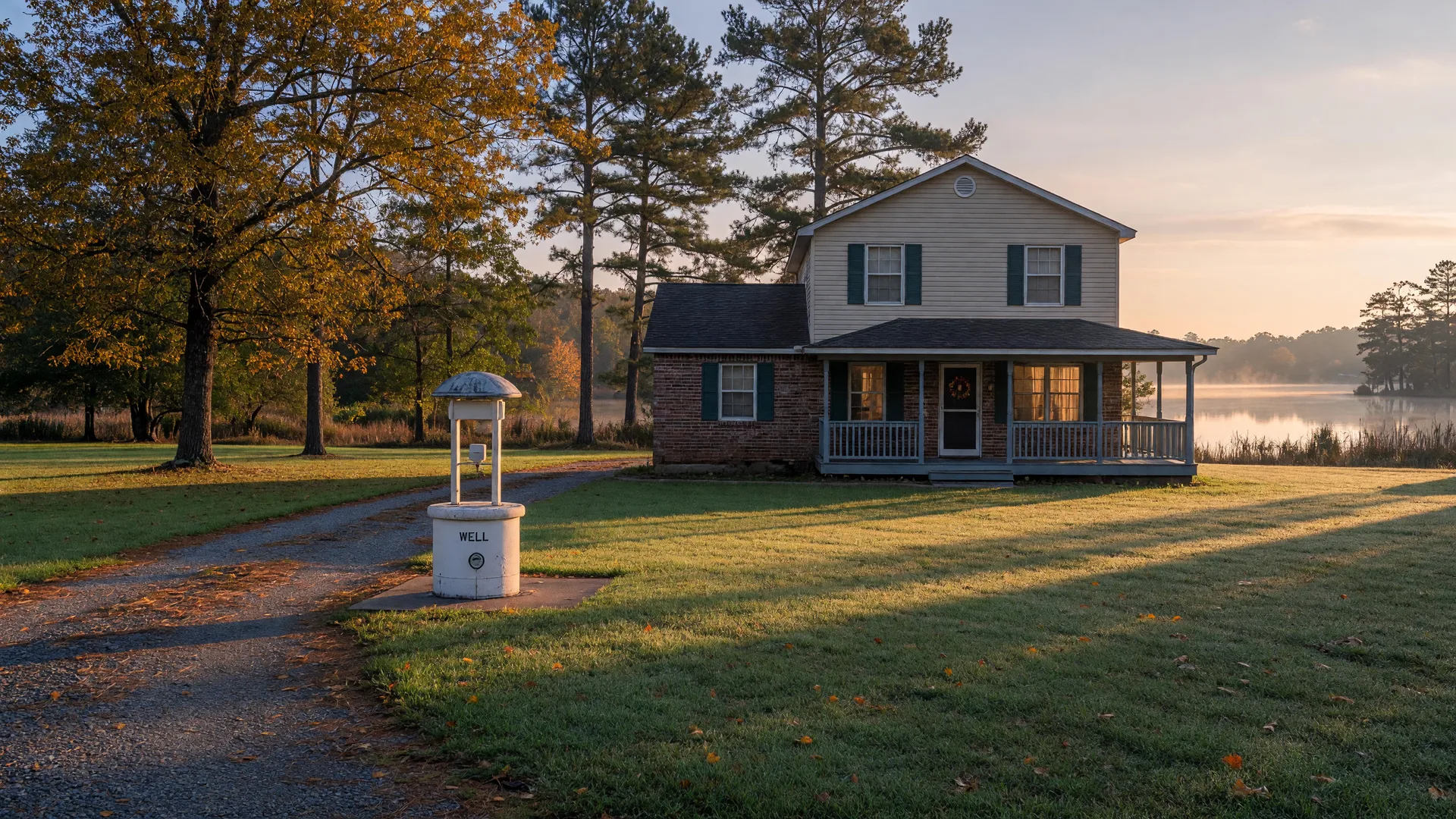
Well Water & Septic
Do Lake Norman homes have well water and septic systems?
Yes and no, depending on which side of the lake you buy on. Cornelius, Davidson, Huntersville, and most of Mooresville sit inside town utility areas with public water and sewer, but the unincorporated parts of Lake Norman are a different story: homes in Denver, Sherrills Ford, Terrell, and the rural fringes of every county commonly run on private wells and septic tanks. That split quietly changes utility bills, financing, insurance, and resale value, and it is one of the cheapest things to verify before you commit to an address. This guide tells you which communities are on well and septic, what a replacement actually costs, and exactly what to inspect during due diligence.
Which Lake Norman towns are on well water and septic?
The simplest way to think about it is the town limit sign. Water and sewer service in Lake Norman is delivered by the towns and the counties, so the four-county line that shapes your taxes and schools also shapes your pipes. The unincorporated areas, where no town provides utilities, are almost always built on private wells and septic systems.
Here is the status quo by area, with the caveat that every property is different and the utility map has exceptions at the edges.
| Town / Area | County | Water | Sewer | Typical Status |
|---|---|---|---|---|
| Cornelius | Mecklenburg | Public (Charlotte Water) | Public | Nearly all homes on city utilities; a few large-lot lakefront properties sit outside the footprint |
| Davidson | Mecklenburg | Public (Charlotte Water) | Public | Nearly all homes on city utilities; rural edges on wells and septic |
| Huntersville | Mecklenburg | Public (Charlotte Water) | Public | Nearly all homes on city utilities; some large-lot and far-west properties on wells and septic |
| Mooresville | Iredell | Town of Mooresville | Public in town | Inside town service areas on city utilities; lakefront lots and unincorporated stretches often on wells and septic |
| Troutman | Iredell | Town limits only | Town limits only | Town core on city utilities; surrounding rural areas on wells and septic |
| Denver | Lincoln | Mostly private wells | Mostly septic | Unincorporated, no town utilities; wells and septic are the norm, often with a lift station |
| Sherrills Ford | Catawba | Historically none; wells | Historically none; septic | Wells and septic are the norm; Catawba County is extending public water and sewer with state funding |
| Terrell | Catawba | Private wells | Septic | Small unincorporated community; wells and septic throughout |
Cornelius
Mecklenburg County
Davidson
Mecklenburg County
Huntersville
Mecklenburg County
Mooresville
Iredell County
Troutman
Iredell County
Denver
Lincoln County
Sherrills Ford
Catawba County
Terrell
Catawba County
The utility map has exceptions at the edges
A neighborhood in Cornelius can be fully on Charlotte Water while the lakefront lots one street over run on wells. The same is true inside Mooresville's town limits, where some waterfront communities were built before sewer reached them. Never assume from the town name alone: have your agent confirm the water source, the sewer method, and the utility provider for the exact address on the listing and in the county records, and ask the listing agent to put it in writing.
Sources: Charlotte Water (Mecklenburg town service areas), Hickory Record coverage of Catawba County sewer expansion (Sherrills Ford), Denver-side septic and lift station guide (2024-2025), septic service maps for the Mooresville to Statesville corridor, and county Environmental Health offices. Utility status varies by address; verify each property.
How much does a new well or septic system cost in Lake Norman?
The price of the house reflects none of this, so relocating buyers are routinely surprised. A functioning system is the norm, but a failing one is a five-figure surprise, and North Carolina's Piedmont clay and rock layers mean costs vary a lot by lot.
| Item | Typical Cost | Notes |
|---|---|---|
| New drilled well, complete with pump and tank | $7,000 to $18,000 | Typical turnkey range for central North Carolina, on lots drilling 200 to 500 feet |
| Deep or hard-rock well site | $18,000 to $40,000 | Where granite and low-yield rock force deeper drilling and extra casing |
| Well pump and pressure tank alone | $1,500 to $3,500 | Common replacement when an existing well loses pressure or the pump fails |
| New conventional septic system (3-bedroom, standard soil) | About $7,240 on average | North Carolina average; typical range about $6,600 to $7,900 for a conventional system |
| Engineered or alternative septic system | $10,000 to $70,000+ | Required where soils are poor, the water table is high, or the lot is small; varies by county |
Sources: T.W. Stanley Well & Pump, 2025 and A&T Well Pumps (well costs), ProMatcher North Carolina cost report and septicandwell.com (septic costs). Ranges are state-level estimates; actual bids depend on the lot, the county, and the soil report.
Why does the Denver side of the lake run on septic and lift stations?
Denver sits in unincorporated Lincoln County, so there is no town utility department with a service area map. Homes there run on private wells, and the wastewater system is a septic tank plus a drainfield, often with an electric pump called a lift station because the drainfield sits uphill from the tank. Lincoln County's Environmental Health office processes a heavy volume of new and replacement septic permits each year, and the county warns that the permit process can take one to two months from application to the first site visit.
A lift station is not a red flag on its own. It is simply how gravity gets overruled: the pump lifts effluent to the drainfield. What matters is whether it was installed correctly, permitted, and maintained. A lift station that fails backs sewage up into the house, so during due diligence you want the pump inspected, the alarm tested, and the service history in hand. See the Denver town guide for how this plays out community by community on the western shore.
The same pattern shows up in Catawba County. Sherrills Ford historically had no county water service at all, and homes there were built on wells and septic by necessity. Catawba County has begun extending public water and sewer into the Sherrills Ford area with state funding approved in the 2020s, but much of that utility buildout is still years from the curb. Today, a Sherrills Ford or Terrell address on well and septic is not the exception; it is the default.
What should you check before buying a well and septic home in Lake Norman?
North Carolina runs on a negotiated due diligence period, typically about two weeks in the Lake Norman market, and your inspection contingency lives inside it. Here is the checklist I walk buyers through on every well and septic property.
Pay for a full septic inspection, not a camera peek
A proper operational inspection runs about $300 to $700 and typically includes pumping the tank, measuring sludge and scum, checking baffles, dye-testing the plumbing, and inspecting the drainfield and grading. Verify the system's permitted bedroom count matches the home, because the county's operation permit caps the house size the system can serve. Older lakeside cottages sometimes have undocumented systems; find out before you own one.
Test the well water at a certified lab
Have a certified laboratory run coliform bacteria, nitrate and nitrite, plus basic inorganics, and ask about the well's flow rate and recovery. New wells in North Carolina must be sampled by the local health department within 30 days of completion; existing homes have no forced testing at sale, so the test is on you. The cost is a few hundred dollars and it answers the single biggest health question on the property.
Pull the county's own records
Each county health department's Environmental Health division keeps the file: Iredell in Statesville, Lincoln in Lincolnton, Catawba in Newton. Ask for the septic operation permit, its bedroom rating, the last inspection date, and any repair permits. Catawba County requires an inspection operation permit at property transfer. These records are public, free, and they tell you whether the system on the ground matches what the county has on paper.
Read the seller's well disclosure
North Carolina updated its Residential Property Disclosure Statement in 2025 to require sellers of homes with private wells to disclose well information. That document is your first window into the age of the well, the pump, and any known water quality issues. If the disclosure comes back thin, that is a reason to test deeper, not to walk away.
Budget for treatment before you move in
Well water around Lake Norman commonly runs high in iron, manganese, and hardness, which shows up as orange-brown staining on sinks and laundry, black staining on fixtures, and scale on plumbing. Local water treatment installers frequently pair a softener with an iron and manganese filter, plus a pH neutralizer or UV system where the water is acidic. Ask the well inspection report for a water chemistry panel so you can quote treatment before you negotiate, not after you close.
Sources: NC law on septic inspections (2025), NCDHHS well sampling rule 15A NCAC 18A .38, NC well water disclosure update (Triangle Law Group, Feb 2025), Catawba County transfer permit guidance, and the Iredell, Lincoln, and Catawba County Environmental Health offices.
Is well water safe to drink around Lake Norman?
Yes, with two conditions: the well has to be constructed to current state standards, and the water has to be tested and treated for what the chemistry shows. The wells themselves are not the problem. The problem is assuming the previous owner's treatment setup matches what you want, because taste, staining, and scale are driven by the specific minerals in your specific borehole, and no two wells on the same road test identically.
The most common Lake Norman well water issues are iron, manganese, and hardness, according to local water treatment companies that service Denver, Sherrills Ford, Mooresville, and the Mecklenburg towns. Manganese in particular is widespread in Piedmont wells, and iron shows up as rust-colored staining and a metallic taste. All of it is treatable, and treatment cost runs from a few hundred dollars for filters to a few thousand for a complete softener, iron filter, pH neutralizer, and UV package.
One more habit worth building: annual testing. Coliform and nitrate can change with heavy rain, nearby construction, or a failing septic system, so the same test you run before closing is the same test you should run every spring. It is one of the cheapest maintenance items on the property and the easiest one to skip.
Sources: Ultimate Plumbing, Mooresville and Artisanal Water Solutions, which cover common Lake Norman well water issues; North Carolina Health News on manganese prevalence in Piedmont wells.
Common questions about well water and septic in Lake Norman
Which Lake Norman towns are on city water and sewer?
Cornelius, Davidson, and Huntersville are served by Charlotte Water with public sewer, and most of Mooresville and Troutman are on town utilities inside the town service areas. Denver, Sherrills Ford, and Terrell are largely on private wells and septic because they are unincorporated and no town provides utilities. Verify the exact address either way.
Do all lakefront homes have public water?
No. Plenty of waterfront lots in Lake Norman sit outside the public utility footprint, including large-lot lakefront properties in the Mecklenburg towns and much of the western shore in Lincoln and Catawba counties. Lakefront status says nothing about water or sewer; the county records do.
How much does it cost to replace a septic system in North Carolina?
A conventional three-bedroom system averages about $7,240 in North Carolina, with a typical range of $6,600 to $7,900. Poor soils, high water tables, or small lots push the job to an engineered system that can run $10,000 to $70,000 or more depending on the county and site conditions.
Is a septic lift station a problem?
Not by itself. A lift station just pumps waste uphill to the drainfield, and it is common on the Denver side of the lake. What matters is that it was permitted, installed correctly, and maintained. Have it inspected, test the alarm, and get the service history during due diligence.
Do I need to test the well water before buying?
Yes. North Carolina does not force a test at sale for existing homes, so it is on you. Run coliform, nitrate and nitrite, and basic inorganics through a certified lab, and ask about flow rate. The updated 2025 Residential Property Disclosure Statement requires sellers to disclose well details, which gives you a starting point.
Does being on well and septic change the value of a Lake Norman home?
It can cut both ways. On the western shore, well and septic is the norm and buyers expect it, so it does not discount the home. In the Mecklenburg towns, a house on well and septic next to city utilities can sell at a discount because buyers fear the unknown. Either way, a documented, permitted, recently serviced system protects the value; an undocumented one is a negotiating lever for the buyer.
Not sure whether the home you are touring is on city water or a well?
I check the utility setup on every property I show, and I have the county Environmental Health contacts saved on speed dial. One conversation before you write an offer beats a five-figure surprise after closing. It is the kind of detail I check on every Lake Norman home, right alongside the hidden costs most relocating buyers never see coming.
Planning a move to Lake Norman?
Whether you are three months out or three years out, the county, town, and community questions come first, before any house tour. Tell me where you are moving from and what you are looking for, and I will point you to the right starting point in Lake Norman.