Wildlife, Safety & Lake Life
Are there snakes in Lake Norman?
Yes, Lake Norman has snakes, and nearly all of them are harmless. The most common snake you will see is the northern water snake, and there are no cottonmouths or water moccasins in this lake at all. The one venomous snake to know is the copperhead, which lives in the wooded yards around the lake. This guide tells you which snakes you will actually encounter, how to tell a copperhead from a harmless lookalike, and what to do if you find one.
Yes, Lake Norman has snakes, and nearly all of them are harmless
Lake Norman, North Carolina's largest man-made lake, sits in the middle of a well-forested Piedmont landscape, and that habitat is home to a healthy snake population. The important part is what kind of snakes they are. Local wildlife guides and snake-removal services in the Lake Norman area consistently report that the vast majority of snakes found around the lake are harmless non-venomous species.
The four species you are most likely to run into, per the Charlotte-area snake guide from Patch and local removers like The Critter Man, are all non-venomous:
Northern water snake
The one you will see on docks, rocks, and shoreline. Eats fish and frogs, totally harmless, and the snake most people misidentify as a cottonmouth.
Eastern rat snake (black snake)
A big, harmless climber that eats rodents. This is the "black snake" local removers say they are called for most often.
Black racer
Fast, sleek, and shy. It will disappear before you finish reading this sentence, and it is a strong reason to keep the rodent population down.
Eastern garter snake
Small, striped, and common in gardens and yards across the area. Completely harmless to people and pets.
Sources: Patch, "Know Your Snakes: Common Snakes in the Charlotte, Lake Norman Region"; The Critter Man, Lake Norman snake removal.
Why do people think they saw a cottonmouth in Lake Norman?
Because the northern water snake looks enough like one to fool almost everyone. It is a thick-bodied snake with dark, blotchy banding that lives in and right at the water, which is exactly where a newcomer expects a "water moccasin" to be. When it feels cornered, it will flatten its body, musk, and strike defensively. All of that is bluster: it is a harmless fish-and-frog eater, and its bites are not venomous.
Here is the fact that should settle your nerves: there are no cottonmouths, also called water moccasins, in Lake Norman. The cottonmouth is primarily a Coastal Plain species in North Carolina, and the Charlotte and Lake Norman region sits well outside its documented range. Wildlife sources covering the lake, including the r/whatsthissnake community and the Patch snake guide, are blunt about it: any "cottonmouth" report from Lake Norman is a misidentified northern water snake.
The one-sentence answer: the snakes you see swimming, basking on docks, and hanging around your boat lift in Lake Norman are harmless northern water snakes, not water moccasins. The lake is outside the cottonmouth's range.
Sources: Appalachian Voices, "Mistaken Identity: Recognizing the Northern Water Snake"; r/whatsthissnake copperhead vs. cottonmouth discussion.
The one venomous snake in Lake Norman: the copperhead
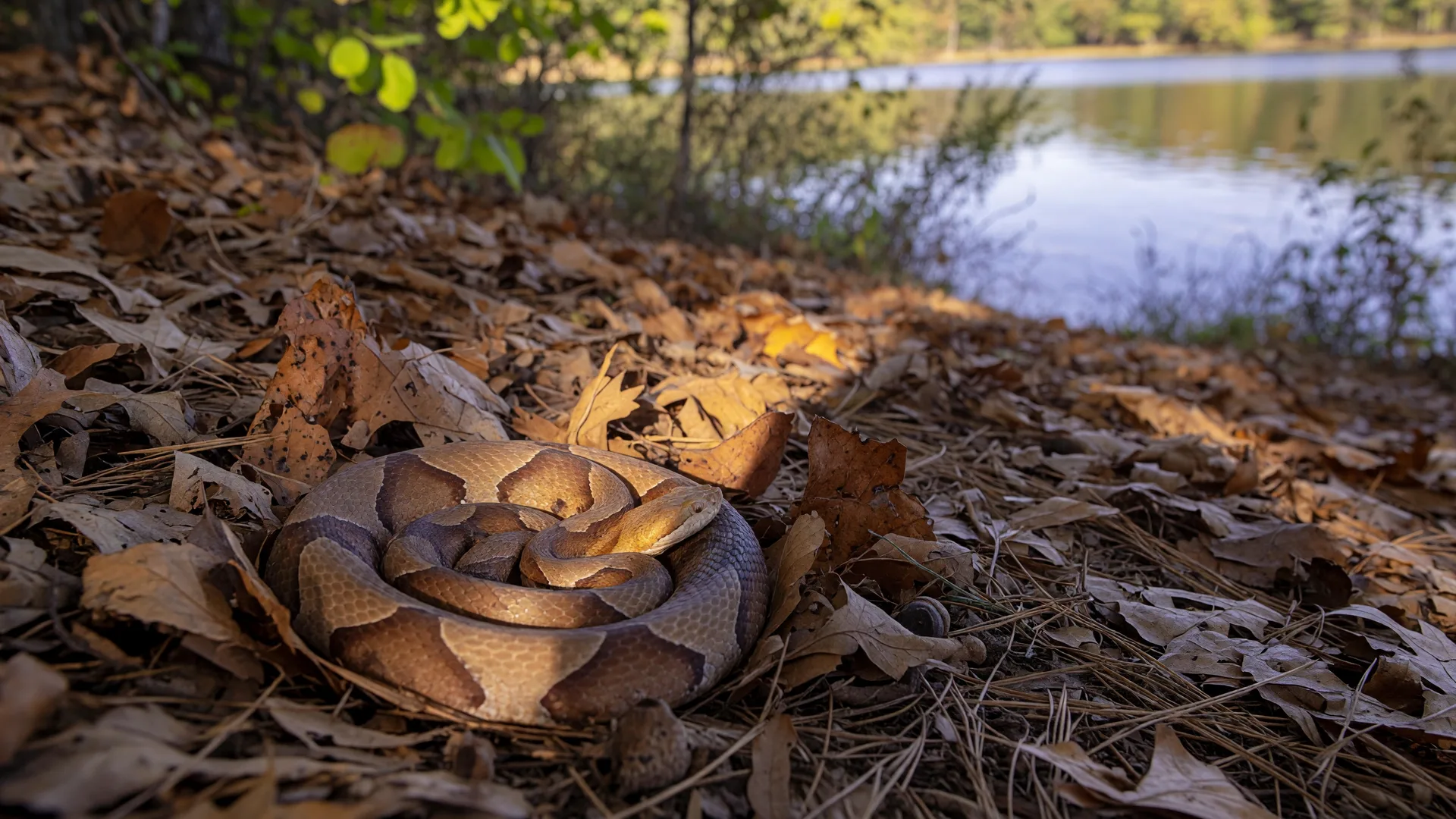
Of North Carolina's six venomous species, the copperhead (Agkistrodon contortrix) is the only one you need to think about in the Lake Norman area, and it is the only one documented around the lake. The North Carolina Wildlife Resources Commission calls the copperhead common statewide, and it has been confirmed right here: the Charlotte Observer reported on a copperhead encounter on the lake as recently as 2022, and copperhead-season reporting from the News & Observer covers the same Piedmont territory that surrounds Lake Norman.
Rattlesnakes, cottonmouths, and coral snakes are either restricted to other parts of the state or extraordinarily rare this close to Charlotte, so the copperhead is the species to learn. Its bite is painful and needs medical attention, but it is very rarely fatal, and antivenom is effective and widely available in the Charlotte area. Still, a copperhead bite is not something you want to gamble on, which is why identification and prevention matter.
Where it hides: copperheads are land snakes. They favor leaf litter, wood and brush piles, rock walls and gardens, and the edges of woods. In a lakeside yard, that means the mulched beds, the stacked firewood, and the rock retaining wall are far likelier hiding spots than the water itself.
When it is active: copperheads are active roughly from March to October, with encounters peaking in summer. They can be out whenever the temperature is at least about 60 degrees Fahrenheit, and in hot weather they turn largely nocturnal, moving most in the late afternoon into the evening.
Sources: NC Wildlife Resources Commission, copperhead profile; Charlotte Observer, copperhead encounter at Lake Norman (2022); News & Observer, NC copperhead season.
Copperhead or harmless water snake? How to tell the difference
When a snake is stretched out flat, most people cannot tell the two apart at a glance. Work through these four clues, in this order, before you assume the worst.
| Clue | Copperhead (venomous) | Northern water snake (harmless) |
|---|---|---|
| Pattern | Hourglass bands, wide at the sides and narrow at the top of the back, clean and well spaced. Often described as Hershey kisses. | Blotchy bands that are wider than the gaps between them. The pattern is duller and never as clean, from reddish to dark. |
| Head | Broad, triangular, copper-colored head, clearly set off from the neck. | Less distinct head. A threatened water snake can flatten its head to look triangular, so head shape alone is unreliable. |
| Eyes | Vertical, cat-like elliptical pupils. | Round pupils. |
| Where you will see it | On land: leaf litter, wood piles, gardens, rock walls, under porches. | In or right at the water: basking on rocks, docks, and boat lifts. |
| Juvenile | Bright yellow-green tail tip. | Grayish blotches on a lighter body, no yellow tail tip. |
Pattern
Head
Eyes
Where you will see it
Juvenile
Sources: Patch, "Know Your Snakes"; News & Observer, how to tell if a NC snake is a copperhead; NatureBlog, copperhead vs. northern water snake.
What should you do if you find a copperhead on your property?
Leave it alone. The North Carolina Wildlife Resources Commission makes the point plainly: a large percentage of copperhead bites happen when people try to kill or handle the snake. A copperhead that sees you first will almost always freeze or slip away, and it wants nothing to do with you.
Keep children and pets back, watch the snake from a safe distance, and give it room to move on. If it has to be removed, call a professional snake-removal service rather than dealing with it yourself. One more thing that surprises people: it is unlawful in North Carolina to take or kill a copperhead without a collection license, because it is a nongame species, so the legal answer is the same as the safe answer, back away and let it go.
Back away
Do not try to kill, capture, or relocate it. Most bites happen when someone tries to handle the snake.
Protect people and pets
Keep kids and dogs away, watch from a distance, and let the snake move on its own. It will.
Call a professional if needed
If it is stuck in the house or in a high-traffic spot, a local snake-removal service can move it safely.
Source: NC Wildlife Resources Commission, copperhead profile.
What should you do if a copperhead bites you or your pet?
Stay calm, move away from the snake, and get medical help quickly. A copperhead bite is painful and always deserves medical attention, but death from one is extremely rare and antivenom works well when you get to care soon enough.
Standard guidance from state wildlife officials: keep the bitten limb at or below heart level, remove rings and tight items before swelling starts, and wash the area gently. Do not apply a tourniquet, do not cut the wound, and do not try to suck out the venom, the old movie tricks make things worse. Call poison control or 911 and let the emergency room know it was a copperhead so they can plan for antivenom.
For pets, a copperhead bite is serious and you should get to a veterinarian right away. Dogs explore with their noses and get bitten on the face and legs far more often than people do, so keep dogs on a short leash in known copperhead habitat, especially in the evening during summer.
Poison Control: (800) 222-1222
Save the national Poison Help line in your phone before you need it. Emergency services know the local hospitals that stock copperhead antivenom.
Source: NC Wildlife Resources Commission, copperhead profile; News & Observer, copperhead bite guidance.
How can relocating families make a Lake Norman yard less snake-friendly?
You cannot snake-proof the woods, and you should not try to. Snakes are a healthy sign of a working ecosystem, and the harmless ones keep rodents in check. What you can do is remove the cover and the food source that concentrates snakes right around your house, which is the practical version of "less snake-friendly" that works on the lake.
Expert yard tips from North Carolina wildlife and pest reporting boil down to four habits: keep grass mowed, clear wood and brush piles, seal the gaps under porches and doors, and do not leave out food or water that attracts rodents, because rodents are the copperhead's favorite meal. Rock walls, stacked firewood, and thick unraked mulch are the three classic Lake Norman hiding spots.
Keep the grass short and the leaf litter raked away from the foundation. Tall grass is prime cover for copperheads hunting at dusk.
Clear wood, brush, and rock piles away from the house. These hold heat and cover, and they are where copperheads hide.
Seal gaps under porches, sheds, and doors. A copperhead can squeeze through an opening you would never notice.
Do not feed wildlife. Bird feeders and pet food left out draw rodents, and rodents draw copperheads.
Source: News & Observer, keep copperheads and other snakes out of your NC yard.
Frequently asked questions about snakes in Lake Norman
Are there water moccasins in Lake Norman?
No. There are no cottonmouths, also called water moccasins, in Lake Norman. The species is primarily a Coastal Plain snake, and the Lake Norman area sits outside its documented range. The water snakes people see and mislabel as moccasins are harmless northern water snakes.
Is it safe to swim in Lake Norman with snakes around?
Yes. Water snakes avoid people and will almost always swim away the moment you get close. Swimming in Lake Norman is safe from snakes; the bigger water-safety questions are covered in our guide to whether Lake Norman water is safe. For the companion wildlife question, see our full answer on whether there are alligators in Lake Norman.
Do copperheads live near the water in Lake Norman?
Copperheads are land snakes. They prefer wooded, leaf-littered areas and can absolutely be found in lakeside yards, but they are not water snakes. You are far more likely to find one in a mulched garden bed, a rock wall, or a wood pile than in the lake itself.
Are some Lake Norman neighborhoods more likely to have copperheads?
Any wooded or leafy community around the lake can host copperheads, since the whole region sits in natural copperhead habitat. Older waterfront lots with mature trees, rock retaining walls, and unraked leaf cover give them the most hiding spots, so those are the yards to keep the most tidy. There is no neighborhood that is snake-free.
What should I do if I see a snake inside my Lake Norman home?
Close the door to the room, keep people and pets out, and call a professional snake-removal service. Most snakes that get inside Lake Norman homes are harmless black snakes (rat snakes) that came in chasing rodents, so removing them is routine for local services.
Are copperhead bites fatal?
Very rarely. A copperhead bite is painful and always needs medical attention, but deaths are extremely rare and antivenom is effective when you get to care quickly. Most bites happen when someone tries to kill or handle the snake, which is why the rule is to back away and leave it alone.
Thinking about making Lake Norman home?
Snakes are a tiny part of life here, and the harmless ones outnumber everything else by a mile. If you are weighing neighborhoods, schools, and waterfront lots, I can show you which ones fit your family. One conversation is all it takes to start.
Planning a move to Lake Norman?
Whether you are three months out or three years out, the county, town, and community questions come first, before any house tour. Tell me where you are moving from and what you are looking for, and I will point you to the right starting point in Lake Norman.